
Rise of the Nones in America: They Simply Stopped Believing
Following graduate school, I served as a leadership consultant for preaching and worship within a major denomination. My first assignment involved stewarding an existing initiative titled “Let’s All Go to Church.” This growth campaign was designed to capitalize on a traditional social expectation that people should attend services, yet it failed to account for the emerging rise of the nones in contemporary American religious life.
That was in 1991.
Even then, I recognized the program was a conceptual failure built upon a terribly outdated assessment of culture. It ignored the shifting landscape where religious affiliation was no longer a default social norm.
My first self-assignment?
Instead of “Let’s All Go to Church,” it was, “Hey, Let’s All Come Up with a New Idea.” That new idea was titled, “Opening the Front Door.” Rather than reminding people to do what we (wrongfully) assumed they knew they should do (attend church), how about creating a church people would actually want to attend?
But even that idea is now passé.
You can think of the progression this way: In the ’60s and ’70s, you could play off of guilt and obligation to get people to attend a church. In the ’80s and ’90s, and even into the early 2000s, you could open the front door of the church in such a way that it would attract people who had been turned off to church.
Today?
The latest research from the Public Religion Research Institute (PRRI) has found that 26% of Americans now identify as religiously unaffiliated, making them the largest single religious group in the U.S. This isn’t exactly news. My book The Rise of the Nones came out in 2014. What has changed is that the number of atheists within that percentage has doubled since 2013, as has the number of agnostics. Another new dynamic is that not many of those who are unaffiliated are “looking for a religion that’s right for me.”
As in just 9%.
Also news? The reason why people are joining the ranks of the religiously unaffiliated.
Many news articles on the PRRI report highlighted that nearly half (47%) of all respondents who left a faith tradition cited negative teaching about the treatment of LGBTQ people, rising to about 60% of Americans who are under the age of 30.
This was not the headline. I would even argue that the PRRI numbers on that matter were inflated, as the question was posed in far too broad of a way. Instead of asking specifically about a particular religion’s teachings about gay or lesbian people as a reason for leaving their childhood religion, they phrased the reason option as, “The religion’s negative religious teachings about or treatment of gay and lesbian people.” Those are two different things, and if separated from each other would have arguably made “treatment of” a more significant issue than historic Christian orthodoxy.
No, the biggest and most concerning revelation of all was the number one reason people gave for leaving a faith tradition. Ready for it? Sixty-seven percent of people who left a faith tradition did so because they simply stopped believing in that religion’s teachings.
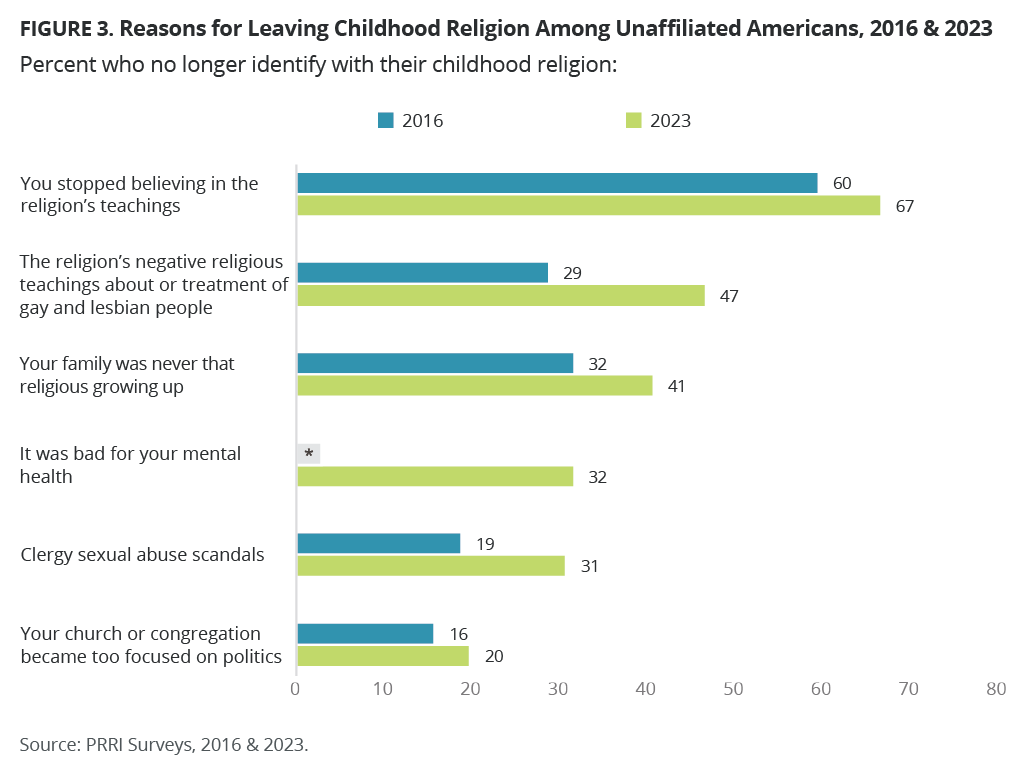
It’s not primarily a cultural rejection (as in rejecting traditional, historic Christian orthodoxy on such matters as all things LGBTQ). It’s not simply a yawning disinterest. Today’s religiously unaffiliated are increasingly simply rejecting the message itself.
They are, in short, card-carrying unbelievers. And unless something intervenes, their numbers will grow. Only 3% of Americans who grew up in a religiously unaffiliated home said they joined a religion.
But take heart. There can be an intervention. There is something the church can do that would, quite literally, change our world.
They can get back to evangelism. Not talking about evangelism, or exhorting people to evangelism, but actually doing evangelism in effective and arresting ways.
That will take change; that will involve death to self; that will demand the embrace of new and innovative approaches, not least of which is the embrace of the digital world; that will require answering questions the world is actually asking and connecting the gospel to those questions.
It will take work. Hard work.
So I suppose it all comes down to one thing:
How much do we really care?
Read more from James Emery White »
This article originally appeared on ChurchAndCulture.org and is reposted here by permission.
Sources:
“Religious Change in America,” PRRI, March 27, 2024.
Jason DeRose, “People Say They’re Leaving Religion Due to Anti-LGBTQ Teachings and Sexual Abuse,” NPR, March 27, 2024.
Yonat Shimron, “Study: Unaffiliated Americans Are the Only Growing Religious Group,” Religion News Service, March 27, 2024.
