
Addicted to More
American society is entrenched in consumption. Part of this is the natural work of producing, purchasing and consuming the food, clothing, transportation and shelter we need to live. But America has created a society with an endless drive to produce and consume more and more.
Presidential elections are often won based on a candidate’s perceived ability to handle the economy. Prestige is given to those who accumulate the most or who lead companies that produce the most. People fret over avoiding recessions that signal a slowing of this cycle and obsess over when an interest rate reduction might make it cheaper to consume more.
Our faith does not deny that buying goods and services have their place. In fact, God created work that quickly involves the exchange of its produce. And he wanted our endeavors to expand as he commanded us to subdue the earth. But the Bible also hammers home the radical message that consumerism cannot satisfy (See, for example, 1 Tim. 6:6–10).
Recently, Lifeway Research surveyed Americans regarding consumerism and contentment. Their responses provide insight into how churches can offer biblical hope in a culture that looks elsewhere.
Hunger for More
Self-reported signs of greed are not as widespread as you might expect, considering the advertising we are bombarded with or the financial reports of American consumption. But the number of people who admit to being in a consumeristic rat race is still significant.
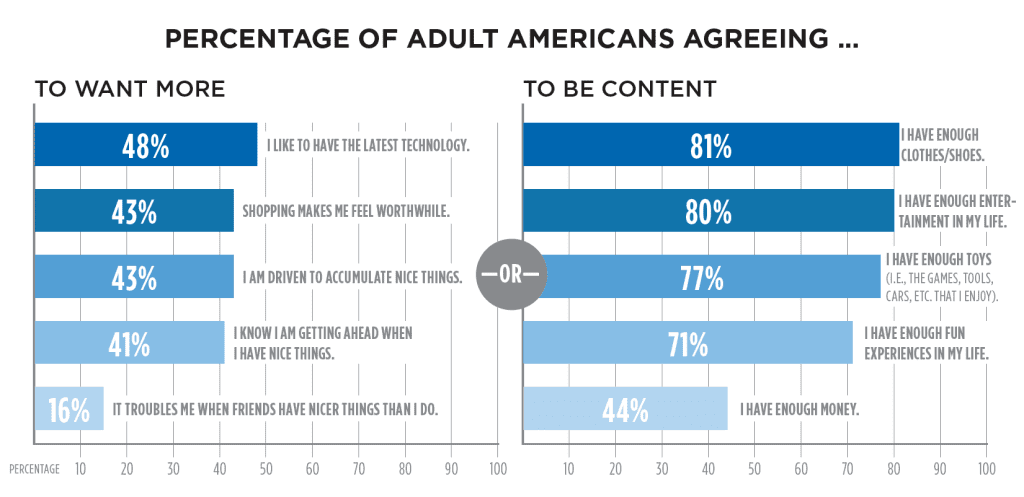
Just under half of American adults agree they like having the latest technology (48%). Almost as many are driven to accumulate nice things (43%). Close to 1 in 6 say it troubles them when friends have nicer things than they do.
There is nothing wrong with having nice things, but relentlessly craving more raises questions about our hearts. The last of the 10 Commandments prohibits coveting, including the phrase “or desire your neighbor’s house” (Deut. 5:21).
Believers are to guard our hearts and our desires. Loving the Lord our God with all our heart leaves no room for desiring more and more stuff. As we seek first the kingdom of God, Jesus promised he will provide for us (Matt. 6:33).
Young and Restless
This countercultural message of contentment found in God himself may sound especially foreign to young adults. Seven in 10 Americans ages 18–34 say shopping makes them feel worthwhile (69%).
Young adults are also the most likely age group to say they are driven to accumulate nice things (69%), and two-thirds like to have the latest technology (65%). The majority define getting ahead as having nice things (57%). More than a quarter are troubled when their friends have nicer things than they do (27%).
We live in a culture that encourages young people to find their identity and worth in conspicuous consumption. Such ventures deny our inherent worth as God created us in his image. Some amount of shopping indicates I have worked as God made me to, and I can now exchange those wages for things I need. But finding value and meaning there is a misguided pursuit that should be directed toward desiring God.
Mammon in the Church
This draw to live for more of what this world creates rather than our Creator is not unique to modern-day America, but neither is it exclusive to secular culture. God addressed it with the people of Israel in the 10 Commandments, and this distraction from serving God wholeheartedly is present in the church today.
More than 6 in 10 people who attend religious services more than once a week (61%) say shopping makes them feel worthwhile. The same percentage (61%) say they are driven to accumulate nice things, compared to 37% of those who never attend.
Americans with evangelical beliefs are also more likely than those without evangelical beliefs to say shopping makes them feel worthwhile (53% v. 39%) and that they are getting ahead when they have nice things (47% v. 39%).
Around half of those who believe in the authority of God’s Word, the necessity of Jesus Christ’s death to remove our sin, and the importance of personally sharing the gospel with others say they find their own measure of success and worth in obtaining more things.
Houston, we have a problem.
It is no wonder that the work of the church in America often feels half-hearted or compromised. Repeatedly, the psalmist says, “Those who make them [hand-made gods] are just like them [not alive], as are all who trust in them” (Ps. 115:8). Followers of Christ need to have honest conversations about our pursuit of the god of consumption if we are ever to be totally living for Jesus.
Seeking Contentment
Despite all this, 8 in 10 Americans agree they have enough clothes or shoes (81%) and entertainment (80%). Almost as many say they have enough toys (77%), and 7 in 10 have enough fun experiences in their life (71%).
This suggests Americans are highly content. Yet, as we’ve already seen, more than 2 in 5 (43%) say they are driven to accumulate nice things.
Why would you be driven for more when you have enough? Many don’t want to admit it, but enough doesn’t satisfy. And more or nicer things don’t either.
Eight in 10 Americans are admitting they have hit what globally would be considered a good measure of wealth. Having enough is not normal in our world, but it is in our country. Yet only 44% believe they have enough money.
Admittedly, some of this lack could be due to real deficits in education, transportation or housing. But the stark contrast of so many having enough of life’s pleasures but not feeling they have enough money indicates many are consumed by greed for more.
God has given us something to offer our neighbors that is much more satisfying. Isaiah says, “Why do you spend silver on what is not food, and your wages on what does not satisfy? (Isa. 55:2). In this chapter, the prophet records the Lord calling the hungry and thirsty to come, and promising them a permanent covenant with him.
His invitation to “seek the Lord while he may be found” must have been astounding to those who heard it, because seeking the Lord requires abandoning the path you are on. God underlines the sharp contrast in our ways, saying, “For my thoughts are not your thoughts, and your ways are not my ways” (vv. 6–8).
But God’s offer that he has asked us to share with others comes with more promises. In addition to the eternal riches of God’s covenant, he promises that those who seek him will go out with joy and be guided in peace (v. 12). What better description of contentment is there than the presence of the joy and peace that so many lack?
While giving up the desire to consume more may seem like a high cost, the gospel offers a much better deal.
