
Bible Study Evangelism
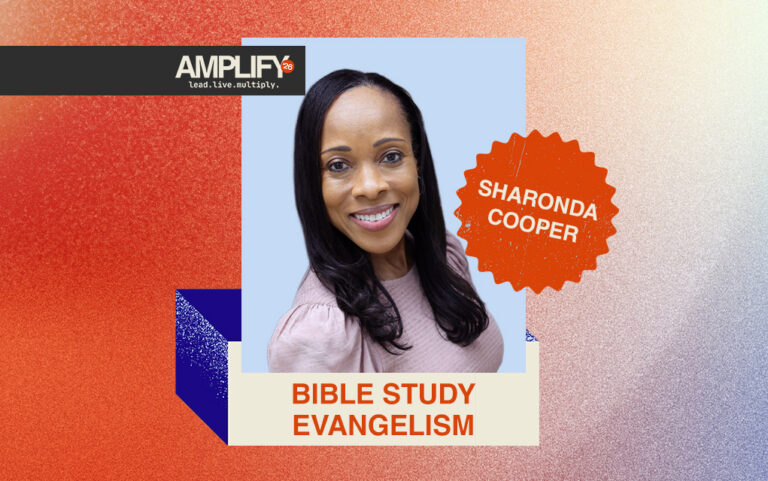
Over the course of their lives, a majority of Christians will study the Bible with other Christians in a small group or one-on-one setting. These are great times to form relationships and deepen our understanding of Scripture. But have you ever considered using a Bible study as an evangelism tool? Sharonda Cooper has. And it’s given her some helpful insights into the best ways to invite our non-Christian neighbors into spiritual conversations through studying Scripture together.
Cooper serves on the Women’s Initiatives Team at The Gospel Coalition and is the author, most recently, of Evangelism, part of The Gospel Coalition’s Disciplines of Devotion series. She is also a main stage speaker at the upcoming Amplify Conference, Oct. 20–21 at Wheaton College, in partnership with Outreach magazine.
In the following conversation, Cooper talks about how she invites her non-Christian neighbors to study Scripture with her, how she responds when someone asks her a hard question, and what she’s learned both when people are receptive and when they’re not.
When you think about studying the Bible, there are so many different ways that people do it. So how do you like to open up the Bible, particularly for people who are encountering it for the first time?
The first time I ever really read the Bible with a nonbeliever as an adult, I did not have any particular plan in mind. I remember the first meeting we brought our Bibles. She had a dusty, dusty old Bible that she found somewhere in her house, and I brought my study Bible and we talked about Scripture. We just opened it up. It was just let’s read and talk.
But over the years, doing this multiple times with non-Christians, I have actually developed a plan that works for me. And I’m not saying that this is going to work for everybody, but I do think it makes a lot of sense. I’ve noticed that in our culture, people need to be convinced first that there is a problem. Because a lot of people believe that there is no problem. That they can enjoy as much sin as they want, and there’s no repercussion for that. There’s no consequence.
So I start in Genesis 1–3 to show them how did the world become this way. We can all agree that the world is a broken place, that there’s racism and injustice and lots of pain and suffering, but why is that? So I start [there] to help the person understand that yes, there is something wrong, and it’s called sin.
Then I take them to the very end of the Bible, the last two chapters of Revelation, to show them that this is the world we’re actually made for. God made us for a world that has no suffering, no sin, no pain, no crying, right? That’s the world that we are actually designed to live in. And don’t you feel it? Don’t you want that? Every single person on earth wants what Revelation 21 and 22 describes. So at that point, Lord willing, the person feels this conflict inside. They know that this is a religious message and they want what it offers, but they don’t really know how to get it. And they’re not really sure that they want to do what’s required.
So then I take them to one of the four Gospels and we start working passage by passage to introduce them to who Jesus is. Jesus is the missing link between Genesis 3 and Revelation 21 and 22. If you want to live in that world, the only one who can help you do that, the only one who can provide that kind of world is Christ. You must come through Christ. I’ve seen people come to Christ as a result of reading [those passages].
How do you navigate the difficult passages of Scripture?
When you’re having conversations with nonbelievers, various things will come up and there will be questions that you can’t answer. I’m not saying that there is no answer, but there are times when you’re talking to somebody about Christ and they throw out a question and you can’t answer it.
The first thing I would say is that you should not be discouraged by hard questions. I actually think hard questions are great, because [they] cause me to go home and do some more research, learn some more things, and I’ll come back, and we’ll be able to talk about it again.
