
Art, Faith and the Beauty of Brokenness: An Interview with Makoto Fujimura (Part 1)
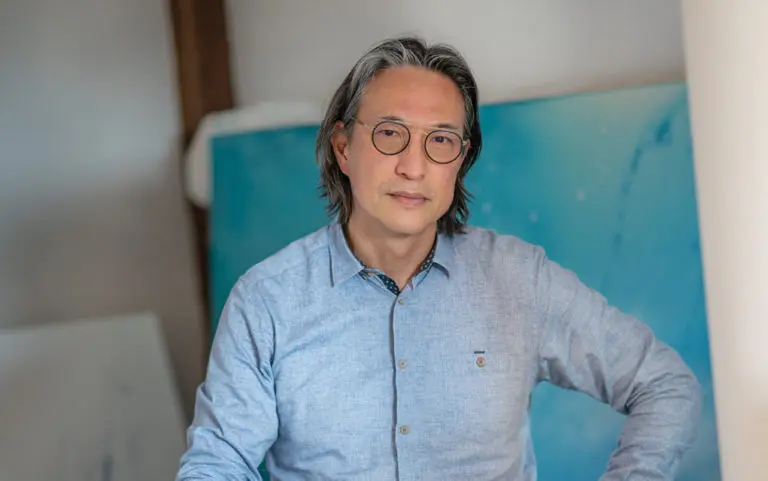
Makoto Fujimura is a leading contemporary artist whose process-driven, refractive “slow art” has been described by David Brooks of The New York Times as “a small rebellion against the quickening of time.” His art has been featured widely in some of the most prestigious galleries and museums around the world. He was also one of the first artists to paint live on stage at New York City’s legendary Carnegie Hall as part of a collaboration with composer and percussionist Susie Ibarra.
Fujimura is also an arts advocate, writer and speaker who is recognized worldwide as a cultural influencer. A presidential appointee to the National Council on the Arts from 2003 to 2009, Fujimura served as an international advocate for the arts. The author of several books, including Refractions (NavPress), Culture Care (IVP) and Silence and Beauty (IVP), Fujimura recently added a new title, Art + Faith: A Theology of Making (Yale), which he describes as a book distilling his life’s work.
But behind his impressive CV, four honorary doctorates and widespread acclaim, Fujimura is simply and obviously a man in love. He sees his work and his faith as inextricably woven, with love for the Creator and the creation central to his creative process and message of culture care. The sense of patience and honor present in Fujimura’s images evokes deep emotion and demands we connect body and spirit to appreciate them fully.
Outreach editor-at-large Paul J. Pastor caught up with Fujimura for a conversation on art and faith, highlighting the power of creativity to both express and inspire the life of faith, especially the power of God’s creative Spirit to lead a broken people into the Lazarus culture of Christ’s “new newness.”
Can you sketch your background for our readers?
My father was a well-known research scientist, a pioneer in acoustics and speech and hearing sciences. I was born in Boston when he was doing postdoctoral work with Noam Chomsky. Soon after, he carried his research to Sweden, where we spent a year and a half, then moved to Japan. There my father was a professor at Tokyo University, the first chair of speech and hearing sciences there. After some time, he was recruited back to the U.S., to the famed Bell Labs.
I came back to the United States when I was 13. By that time, having gone to Japanese grade school, I had lost most of my English. My whole life can be defined by this sense of being culturally bilingual—to write anything, let alone a book, seems so miraculous to me because I’ve never felt like a master in any language. That’s part of the reason I felt so drawn to the arts, especially visual art—it does not require mastery of any one language.
I went to middle school and high school in New Jersey, then to Bucknell University, where Tim Keller went as well. Liberal arts studies—although I went in as a science major and came out as an art and science double major. It was a formative time.
After college, I decided I wanted to make a go at being an artist full-time, which, of course, felt crazy. But I really felt called to do this. So, I went back to Japan and received a government scholarship to study at a very prestigious lineage program in Tokyo, through the Tokyo University of Fine Arts. I was very fortunate—I am still to this day the only “outsider” who’s ever been admitted to this lineage doctoral-level program, which harkens back to the 15th century. I studied under the masters directly, and had access to temples and museums. I was very much drawn to the 17th century art aesthetic of Nihonga, which is a unique Japanese-style painting using traditional materials, mineral pigments, gold and silver, or styles of calligraphy ink from way back.
My intention was to eventually apply everything I learned there to contemporary art. It was in the process of my studies that I became a Christian. Kind of an unlikely way to find Christ, but as I write in Silence and Beauty, God had a purpose for all this. There was a very distinctive, hidden, cultural Christianity in Japan that is, in a sense, very pure. I was able to encounter that tradition through my studies. This became the basis of my faith.
