
What Jesus Really Endured on the Cross—A Medical Perspective
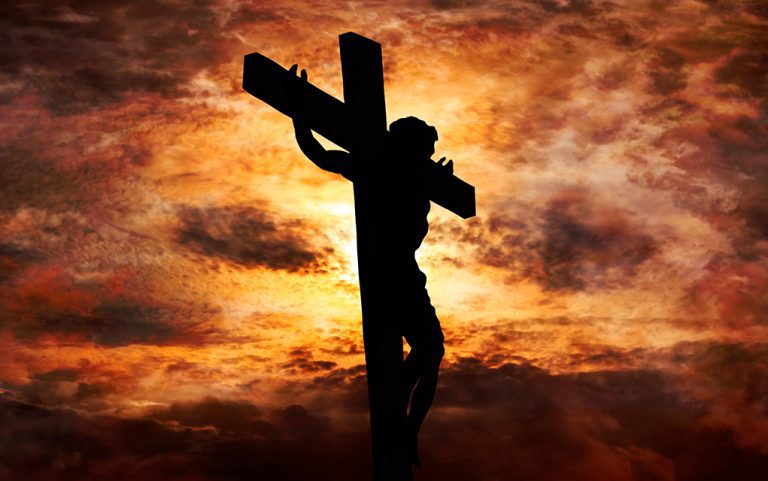
To envision the pain and emotional stress Jesus endured, it may be helpful to share an analogy.
Imagine your family has allowed you to go by yourself to see some old friends you haven’t seen in many years. They live in a remote, desolate area of the Texas desert. You want to surprise your friends, so you don’t tell them you’re coming.
You turn off the main highway and travel for miles on a dusty dirt road, then fail to negotiate an unexpected sharp turn. Because of the heat you neglect to buckle your seat belt. The car rolls over, and you are thrown out of the car. As you fall out of the car, your scalp is cut by the edge of the door.
You land on your back in a bed of prickly cacti. You suffer multiple cuts to your back. The back of your leg lands on a sharp rock which cuts the artery behind your knee. You cannot get up because the door of the overturned car has your legs pinned. You can’t find or reach your cell phone. Your suitcase has fallen on your chest and you can’t move it. You have trouble breathing. Every time you try to move, the pain becomes excruciating. You are literally abandoned. You see your blood seep out of your body and over the next few hours you become faint, as you slowly go into shock. You know you are dying, and there’s nothing you can do.
Friday Noon
Jesus must have looked pitiable on the cross. After being picked up from the supine position on the ground and raised onto the cross, he would have experienced orthostatic hypotension. This is what you feel when you suddenly get up, if your blood pressure is low. It takes a while for your heartbeat to catch up, pumping the blood you need to your brain. You will feel faint and dizzy and may actually pass out.
Jesus would be pale and ashen. His skin would be blood colored from the hematidrosis. Many scholars say that hematidrosis would have caused his skin to be friable and tear easily. His back would have been covered with dirt, except where it was starting to be washed off by fresh bleeding from the wounds of the scourging. It was a sunny day. (Jerusalem has an arid climate, getting only a few inches of rain annually, usually in the autumn.) There was no shade for him.
Jesus probably vomited. We know from emergency room experience that victims of trauma frequently vomit. The pain and shock causes the stomach and intestines to become immobile. The continued production of stomach fluid causes it to accumulate in the stomach, and since it can’t go down into the intestine, the patient vomits it up.
The danger is that it could get into his trachea and lungs, producing what is called aspiration pneumonitis. This causes congestion in the lungs. Recall that Jesus already had fluid in his lungs from the scourging and the falls.
This would have led to poor oxygenation of the blood, causing him to breathe faster (tachypnea). Because of the unrestrained falls he experienced on his way to Calvary, Jesus probably developed pericarditis. The bruising of his chest caused inflammation in the pericardium (the sac around the heart). I have been told by patients who had open heart surgery that if they get pericarditis, it is very painful. Pericarditis causes shortness of breath, heart palpitations, low-grade fever and an overall sense of weakness and fatigue and cough.
Jesus had not slept for 28 hours. Sleep deprivation would have intensified his fatigue and pain.
Jesus had nothing to eat or drink after the Last Supper. He was dehydrated. His mouth was dry. His tongue would tend to stick to the roof of the mouth. The throat muscles would be weak. This, plus chest congestion, fatigue, and weakness, would make it difficult to talk. We know from biblical references that Jesus spoke only seven times, in short phrases.
