
Breaking the 200 Barrier
By Ed Stetzer

Scaling Leaders by Size
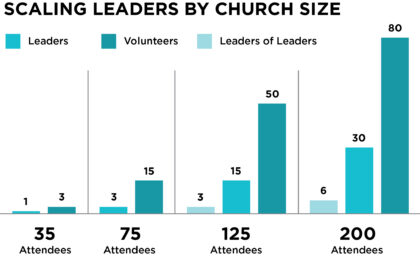
I describe it this way: To be a healthy church of 35, you probably need one leader (and that’s probably the pastor) and three workers (or volunteers) to help.
But to be a church of 75, you are going to need some leaders beyond the pastor, typically two more for a total of three. Those leaders are doing more—and thinking more—and leading more. Before the pastor did almost all of the leading, but now teams are forming and those three leaders are working with 15 volunteer workers.
When they do get to a healthy 125, a new kind of leader has to emerge—a leader of leaders. And this is why so many churches get stuck. It’s harder to be a leader of a group of leaders, but it makes all the difference. Soon you as pastor have a right-hand man (or woman)—and a left-hand one too. They are leading your leaders who are leading the worker volunteers. Systems are beginning to hum.
Then, to break 200, that scale roughly doubles again; however, if you can get to 125 healthily, you already have some of the patterns to get to 200. But if you never developed leaders of leaders at 125, you have some work to do—and many breakdowns take place right here.
Here’s a graphic from my RightNowPastors+ course that helps unpack this idea.
The Next Chapter
Developing leaders involves more than an event or class. It shifts significant portions of the pastor’s calendar toward intentional investment to equip and release emerging leaders. This move doesn’t eliminate the pastor’s care. Instead, it multiplies and distributes it across a growing team of equipped leaders. The result isn’t a lesser form of church but a form of church as Paul describes in Ephesians 4.
Pastors and congregations also need to move from personality-driven leadership to vision-driven leadership. Churches that break 200 and sustain that growth are held together by a compelling, biblically rooted vision instead of the magnetic personality of a single leader. When people understand why their church exists, who it is trying to reach, and their important role in the work, they can own the mission themselves. Shared ownership of the vision is what makes growth sustainable over the long term.
It gets personal for most pastors at this point. Key to our call to ministry is our love of people. We love the connections, the pastoral conversations, and the privilege of being present in life’s most significant moments.
This shift creates a new chapter in the pastor’s calling, one that multiplies care beyond one person’s capacity. And it goes hand-in-hand with a renewed commitment to evangelism.
Evangelize Your Way Into Growth
Leadership, structure and organization are critical, and yet we need to realize that they aren’t the heartbeat of our calling. You can’t just organize your way into growth. You must evangelize your way into growth. Pastors can create more space for their own witness while opening pathways for growth by enlarging and equipping the leadership.
Too many church-growth conversations focus on systems and strategies. They end up missing the motivating heartbeat underneath the conversation itself. The mission of God is about reaching people who don’t yet know Jesus. Evangelism motivates and focuses healthy churches. While people moving from one church to another and transfer growth aren’t always negative, we should build systems to serve mission and evangelism rather than moving around the sheep.
We must develop an evangelistic culture within our churches. How? By thinking about how people who don’t know Jesus might experience our churches on a Sunday morning. By actively investing our time and treasure into serving the community. And by training our congregations to share their faith with others.
Foundationally, this means we orient the posture of the body of Christ toward people who are far from God, those who aren’t yet in the church. Just as leadership development is a culture more than a class, evangelism is also a culture more than a collection of events or Sunday worship experiences. In fact, a culture of evangelism and a culture of leadership development are two sides of a single coin.
Leadership Development Is a Form of Discipleship.
Evangelism isn’t separate from discipleship, and discipleship isn’t separate from leadership development. Each one is a point along the same journey toward learning to be more like Jesus. Think of leadership development as a critical piece of discipling your church.
When someone comes to faith, they begin a journey of discipleship. As they mature, they are equipped and empowered to do ministry. Eventually, some will lead others. Evangelism leads to discipleship, which matures into leadership. A church’s leadership pipeline is, at its core, a discipleship pipeline.
I’m not suggesting that leadership development should become your whole vision for spiritual formation. But I am suggesting that developing healthy leaders should be integrated into the vision for forming your congregation. One tool in this pipeline is meaningful church membership. The New Testament church was intentional about tracking people in order to care for them. Paul’s instruction to maintain a list of widows in need is a key example of pastoral intentionality (1 Tim. 5:9).
