
How Pastors Can Build Spiritual Resilience
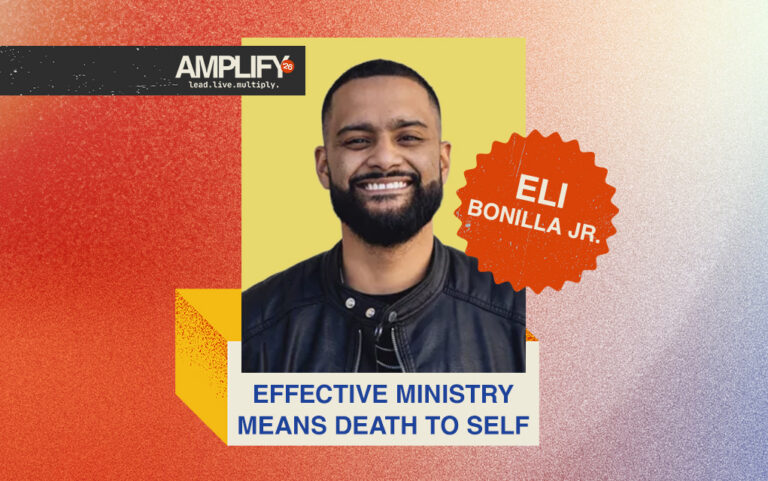
Eli Bonilla Jr. has done a lot of thinking on what makes some pastors resilient when other pastors burn out. Though there are various root causes specific to individual leaders and churches, often burnout begins when church leaders lose their spiritual center. They start to depend on processes, self-reliance, and ministry growth over dependence on God. For him, the source of resilience comes from a paradoxical yet familiar place: Christ’s call to die to ourselves that we might live.
Bonilla is next gen regional co-chair for North America with Empowered21 and next gen director for the National Hispanic Christian Leadership Conference (NHCLC). He also serves on the staff of Abundant Life Church in San Antonio, Texas, and is author of the upcoming title Death to Self Help (Thomas Nelson).
At the Amplify Conference, October 20–21 at Wheaton College, in partnership with Outreach magazine, he will be leading a session helping church leaders become resilient, remain faithful to their calling, and lead with endurance.
In the following conversation, Bonilla talks about cultivating spiritual resilience amid the pressures of ministry, why we need to embrace Christ’s call to die to ourselves, and the keys for church leaders to effectively reach and equip the next generation for ministry.
You’ve done a lot of thinking on how pastors and church leaders can remain resilient in the midst of the busyness of ministry. What do you think are the keys to pastors staying resilient in what they’re doing?
I think the bottom line, especially here in the West [and] the U.S. in particular, [is] comparison kills calling—looking around [at] bigger, faster, stronger [churches], you know, the ministry industrial complex, [in an] attempt to do more. We don’t nearly understand how fleshly and less spiritual we’ve become in the era that we’re in right now.
In my own personal pursuit of spiritual resilience, I have found that there really, truly is no replacement for the spiritual devotion, disciplines, [and] diligence that a minister needs in order to continue on this path of ministry. We have such an anemic landscape of conferences and outright messaging around that deep spiritual connection that [first] got us all into this. [We’ve replaced] that deep, profound, transcendent, can’t place my finger on it but I know I experienced it moment with Christ, [with] a more rational, logical business framework of how ministry is done.
That’s not to say that we should drop all the mechanics of it and all the tools that come with building better ministry. But I feel as though we [too often] make it our goal as ministers to make ministry more efficient, our lives more efficient, in order to ease the burden and the complexity and the pressure that comes from ministry without understanding that it is possible to be efficiently miserable. You could have a bigger church and still be miserable. Your church could be growing faster and you could still be miserable. You could get all the accolades, you could have all the things that come with what looks like successful ministry, and completely forfeit a spiritual center.
[We need to] return to a spiritual place where the Lord continues to surprise us and do things that are unexplainable, because, to be honest, I think the church in the United States is still way too explainable. It feels too much like we can explain how this is moving because we know where we pressed the button, we know how we raised the person. That causes a formulaic style of ministry that robs us of a deep spirituality [and] ultimately leads pastors into seeking how they can help themselves and their ministry more than a pursuit of Christ at the center.
How do you get people, especially church leaders, to start thinking in terms of dependence when that feels so vulnerable, so dangerous? When we’re tempted to be self-reliant?
The culture has put a cape on ministers. We don’t perhaps admit it as much as we probably should. There is this sense of a superhero savior complex that is very easy to wrap our arms around because of the way in which society rewards through likes, shares, hyping the pastor up. It really does put self back at the center.
I love that famous Bonhoeffer quote that’s like when God calls a man, he bids him to die. I ask you this: How much of you is still alive? How much of you are you trying to keep alive in the service to Christ? You died when you first got in it, but then you took off the cross because somewhere along the way someone convinced you it doesn’t require that much sacrifice, that much prayer, that much seeking of the Lord. Your leadership skills are enough. Your education is enough. Along the way we forget what this is. This is a bunch of us admitting that we are weak without God, that we need to die to ourselves daily, that the life that we live in the service we render to the Lord is [as] a living sacrifice.
How do you relate to that death? The way that I would look at it is through the lens of four attitudes: the four attitudes of death. These are some that I came up with that are helpful as you [do a spiritual] audit: Am I still too alive? What are these desires that I should have died to? Have I resurrected them and brought them back? Am I trying to live this ministry life appeasing my fleshly desires?
The four attitudes are all in relation to death to self. The first one is this attitude of, I don’t want to die. Maybe some of you need to stop posting sermon clips. It’s not helpful to you. It gets in your head. It makes you feel like you’re something you’re not, or it feeds something in you. And for whatever reason, you don’t want to stop doing that because then a part of you online will die. And maybe the antidote for you is you need to know the places [where] the Lord is asking you to die but you’re refusing it. Instead of leading the journey with Christ, you’re like, I’ll just do it the way everyone else is doing it, because I’m afraid that if I go the other way it will cost me something or there’ll be a death of my own comfort.
The second [attitude] is maybe you’re in the place of complete despair and you’re like, I want to die. Like, kill me now [like] Elijah or Jonah. We could also be that pitiful martyr where it’s like, Woe is me. No one knows how much I sacrificed. If you’re in that place, audit that. We didn’t get into this for what people could do for us or even what God could do for us once we said yes. We got in this because he already did everything. The cross was good enough for me to get into ministry. If he never did anything else, if I’m just obscure the rest of my life reaching one more soul for him, [that’s OK].
[The] third [attitude] is this defiance of I will not die. We close ourselves off to the voice of the Holy Spirit. We begin to block out wise counsel. I’ll tell you this [truth that] I heard from a much wiser man than myself: Oftentimes we’re looking for a new word from God when we haven’t obeyed the first word from God. And sometimes we don’t obey that first word because we say, “I will not do that.” Then we get to a place where we’re like, Man, God’s not speaking to me like he used to or I haven’t heard from him in a while. I think the Lord does not look at the prideful heart with any type of joy or gladness. As a matter of fact, he rejects the prideful heart. It’s the humble heart, it’s the broken heart, that he begins to bring in.
The last attitude is the Christ-centered one, which is I am willing to die. That’s the attitude of Gethsemane. That’s the attitude of Jesus. At the beginning you were willing to leave it all, to give it all. I’m willing to die. And somewhere along the way you picked up something. And that thing you picked up is a part of that old life you lived and you’re feeding it, you’re trying to keep it alive, you’ve got it on life support. And the Lord’s telling you, “Hey, it’s time to give that up.”
How you relate to death and life in ministry is super important because at the end of the day what has Christ called us to? To die to ourselves. To let go of our life. And if we do that, then we will find the life that Christ has for us.
The church leaders you’re going to be speaking to [at Amplify] are trying to reach the next generation and equip people from the next generation. How can older church leaders help younger, rising church leaders reach their friends?
I know I’m preaching to the choir. Anyone coming to the conference [is] probably well-versed in statistics, but what we’re seeing is the highest rise in spirituality with this next generation. They’re the most spiritual generation on planet Earth right now. That speaks to a generation that is alive to the things that are transcendent. However, this is also a generation that is struggling with truth and trust. Those two are the biggest things that I’ve seen in ministry as I’ve approached reaching and raising next-gen leaders and young adults and youth. There is that spiritual dial that’s there, however they do not trust institutions or leaders. There is a lot of confusion on where trust or truth is. [They’re] just being inundated and flooded with information coming left and right. How do I even sift through [it]? Do I believe ChatGPT more than my pastor? Trying to seek somewhere to handle deeper questions.
[For] any leader that is leading right now in a spiritual capacity, to handle the truth and trust questions [from] your young people requires proximity and consistency. We’re going back to the basics because it just is what it is. Right now the most connected generation is the most disconnected [socially]. They’re needing pastors to be close, connected with them, calling them, meeting with them. As you develop that trust, you know what they will trust you with? Truth. And you’ll get that opportunity. You can invite people to church and they’ll say yes, but ultimately you don’t want to build a crowd, you want to build disciples, and this generation is ready to be discipled. However, there is no shortcut to discipleship if there is not that bond of trust, and if there is not the power of truth
This is the greatest opportunity to disciple in human history. All you have to do is be close with them. Do that over some time. As you’re equipped with the truth, speak it in love, and you’ll see a movement take place. It’s as simple as that.
As you look forward to the future of the church, what gives you hope?
As I look forward to the future of the church, I see a fearlessness in Gen Z and even Gen Alpha. We’re going into times of uncertainty, and millennials and up [are] all kind of freaking out [about] AI and future technologies. I think God is equipping a generation to navigate this. These young people [are] catalyzing movements on their school campuses with technology. I’m also seeing students rejecting technology in ways that greater tech wants them to be inundated, and saying, Hey, you know what? I’m actually gonna go hang out with my friends. The other day I was talking to a young person and they’re talking about hanging out, putting phones down, playing basketball, being outside, and I was like, “Whose idea was it?”
And they were like, “It’s our idea.”
I think they’re ready to lock in and to make a difference, and they’re not fearful for the future. They’re embracing what it could be, and I think it’s a great thing to see.
Join Eli Bonilla Jr. and many other dynamic Christian leaders at this year’s Amplify Conference, October 20–21 at Wheaton College, and learn to lead with gospel clarity, live authentically, and multiply faithfully in the real challenges of ministry today.
