
The Analog Church: Why People Are Craving Real Connection
By Thom Rainer
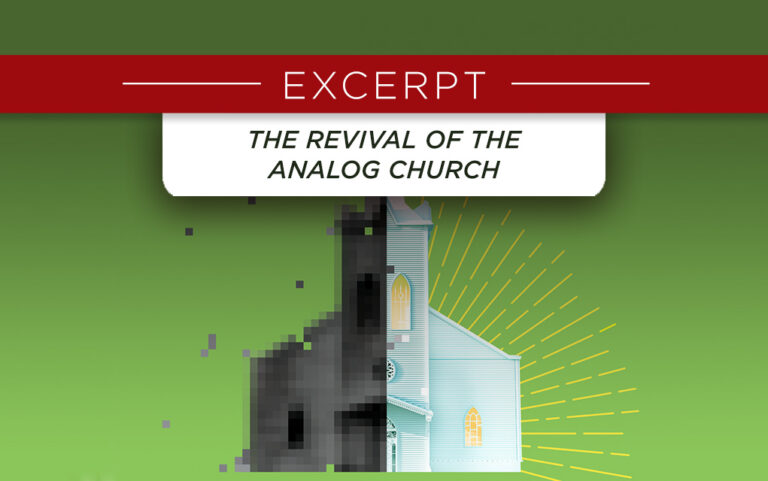
I see it everywhere now. What once felt like a quiet undercurrent is now showing up in plain sight: People are rediscovering the value of the physical, the tangible, the personal. Yes, even in this digital-first, AI-fueled, screen-saturated world, there’s a growing hunger for something slower, deeper, and more human.
Analog is making a comeback.
It’s happening in ways that are both surprising and strangely familiar. Young adults are buying vinyl records at record-setting levels—no pun intended.1 Bookstores are making a quiet return.2 People are handwriting journals, tending to gardens, and choosing board games over video games on a Friday night.
Even some of the people who once raced to digitize everything are now stepping back and asking, “What did we lose along the way?”
That question matters deeply for the church.
We’re not the only ones asking it, but our churches may be among the few positioned to answer it with clarity and conviction. Because while the world is growing weary of a disembodied life, we carry a gospel that is profoundly embodied.
Jesus came in the flesh. He walked, talked, touched, and wept. He didn’t Zoom the Sermon on the Mount.
People are craving what screens can’t give them: presence, slowness, and soul-level connection. So let’s look around. The signs of analog renewal are all around us. And maybe—just maybe—they’re also signs of hope for our churches.
The Church as a Countercultural Refuge
We live in a loud world.
The constant noise—both digital and cultural—presses in from every side. Social media fuels outrage. News feeds stoke anxiety. Algorithms keep us agitated and distracted. Even good things can feel overwhelming. We are always connected, but rarely at peace.
That’s why the church must reclaim its role as a countercultural refuge.
Not a place that escapes reality, but one that offers something radically different from what the world delivers. A place of quiet strength. A people of uncommon grace. A rhythm that resists the chaos.
In many ways, this is what the early church was known for. In the middle of a Roman Empire filled with noise, power, and spectacle, Christians gathered to pray, to sing, to serve, and to remember. Their worship wasn’t flashy. It was faithful. And it stood in stark contrast to the world around them.
Today’s analog church has the same opportunity.
When everything else in life feels like performance, the church can be a place to rest. When the culture demands speed, the church can model slowness. When the world shouts for attention, the church can whisper eternal truth. And when loneliness is rising, the church can offer belonging—not as a slogan, but as a lived reality.
This is not a call to be weird for the sake of being weird. It’s a call to be holy in the most literal sense—set apart.
We don’t need to out-entertain the culture. We don’t need to keep up with every trend. In fact, the more we try to be like the world, the more we lose what makes the church compelling in the first place.
The analog church doesn’t compete with Netflix. It offers what Netflix can’t. Presence. Prayer. Peace. The people of God gathered together, not for consumption, but for communion—with Christ and with one another.
This vision of the church as a countercultural refuge is especially compelling today because people are exhausted by the performance. They’re burned out on curated perfection. They’re disillusioned with institutions that overpromise and underdeliver. But the church can quietly say, “There’s a better way. Come and see.”
And that starts with presence. Not production. With attention, not algorithms. With being together, not being trendy.
We are not the first generation to need refuge. But we may be among the first to realize how deeply people now long for it—whether they can name it or not.
The analog church answers that longing. Not with complexity, but with simplicity. Not with gimmicks, but with grace. It creates space. It offers respite. And it reminds a weary world that there is still a God who welcomes all who are heavy-laden.
In this way, the church becomes a shelter again. A sanctuary. A countercultural refuge where the broken are not fixed in an instant—but loved, listened to, and led toward hope.
The Return of Slow, Embodied Practices
Speed has become the default setting of our world.
We want everything faster—food, information, delivery, results. Even in the church, we’ve been tempted to adopt this pace. Fast-track discipleship. Streamlined worship. Bite-sized sermons. But the spiritual life doesn’t thrive in haste. It never has.
That’s why we’re now seeing a return to embodied practices. And the analog church is perfectly positioned to lead the way.
People are beginning to rediscover what they lost in the rush. They are taking walks instead of scrolling. Cooking meals instead of ordering out. Handwriting letters instead of sending texts. They are asking what it means to live with intention—not just momentum.
In the spiritual realm, the shift is even more meaningful.
Churches are seeing renewed interest in practices like silence, liturgy, journaling, Scripture reading, sabbath, and prayer—not as events, but as habits. People want to feel their faith again. They want to hold something in their hands. They want to live it with their bodies, not just access it through a screen.
Slow practices have staying power. They form us over time. They resist the impulse to impress. They lead us deeper.
The analog church invites people into these rhythms. Not with programs alone, but with modeling. We don’t just talk about prayer—we pray. We don’t just teach about community—we share meals. We don’t just explain the gospel—we live it in tangible ways.
These practices may feel small. But they are how transformation takes root.
Jesus didn’t disciple his followers in a classroom. He walked with them. He sat with them. He shared unhurried moments that formed their hearts over time. His method was slow. His ministry was embodied. His model was analog.
And it still works.
As the world accelerates, people are craving places where they can slow down. Where they can breathe. Where they can belong. The analog church is one of those places.
We are not just brains on screens. We are people with hands, voices, and stories. Faith is not just a belief system—it’s a way of life. And it’s best lived in real time, with real people, in real surroundings.
In this cultural moment, slow is not a liability. It’s a gift. And the church should offer it without apology.
- Dylan Smith, “Thanks, Swifties? US Vinyl Sales Volume Returned to Double-Digit Growth During H1 2024, Report Shows,” Digital Music News, August 30, 2024, https://www.digitalmusicnews.com/2024/08/30/vinyl-sales-us-h1-2024/.
- “Bookstores Have Turned a New Page: 2025 Is Looking Good,” The Currency, January 6, 2025, https://www.empower.com/the-currency/play/bookstores-new-page-news
Adapted from The Revival of the Analog Church: Why Your Church Should Be Personal and In-Person by Thom S. Rainer, releasing in October 2026 from Tyndale House Publishers.
